Sumedh

Install Windows XP from an Usb flash drive on the Eee PC


Published - Feb 27/2008
Last Updated - Mar 16/2008
Author - Sumedh
Note - This tutorial works on all computers not just the Asus Eee PC.


Pre-requisites

- Windows Xp Pro slipstreamed with SP2.
- Bootable Usb flash drive.
- Asus Eee Pc or any other computer with 'Boot from Usb' option supported by the BIOS.
- Download Usb Multiboot2
- Download Bootsect


Start Xp installed on Eee Pc


Formatting

Extract the files in USB_MultiBoot2.zip
Double click the executable named USB_MultiBoot2.cmd
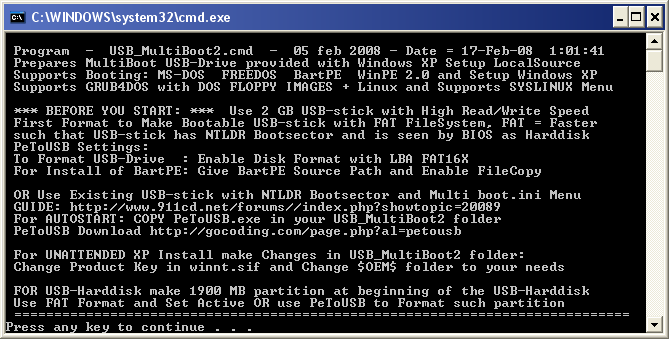

Usb_multiboot2


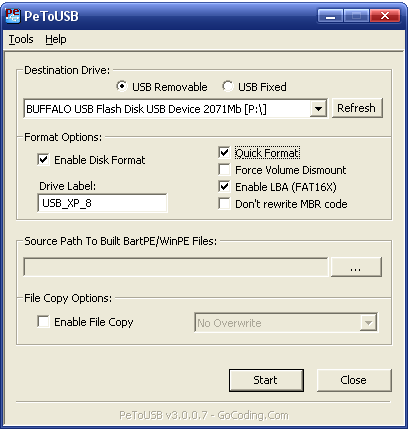
Press any key to continue. The next window will look like this.
Petousb


Select your Usb flash drive from the drop down box. Make sure the 'Quick Format' checkbox and 'Enable LBA' checkbox is checked. Once the format is complete Do Not close the PeToUsb window and USB_MultiBoot2 window. If a new window pops up which displays the contents of the Usb drive, close that window.

Extract the files in Bootsect.zip. Open a new command prompt window. Browse to the directory where you have kept bootsect.exe

Now type "bootsect.exe /nt52 P:"    (without the quotes) and press enter.

Note P: is the drive letter of my USB thumb drive. Your drive letter may be different so make the change accordingly. This command writes the correct boot sector to your usb stick which allows the computer to boot from the Usb drive.

Note - When running bootsect.exe command you cannot have any windows open displaying the contents of the Usb drive.

If the command executes successfully you will see the following message.

Bootsect.exe


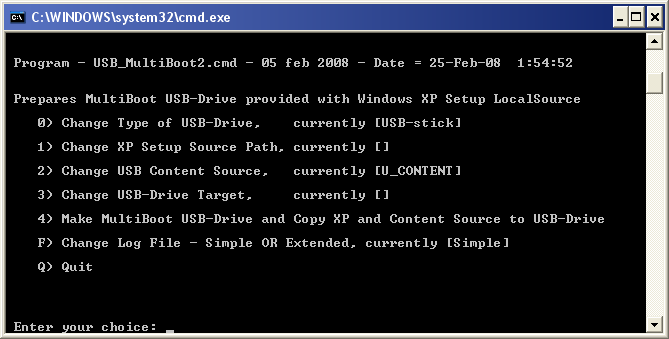
You can close this command prompt window and the Petousb window. Do not close the USB_MultiBoot2.cmd window by mistake. You will get a window similar to this one.
Usb_multiboot


Press 1 and Enter. A browse window will open, browse to the location of your XP setup file ( Can be your cd-rom drive or some folder on the hard disk)

Press 3 and enter the drive letter of your USB drive. (its not case sensitive) After you have finished, press 4 to start the process.
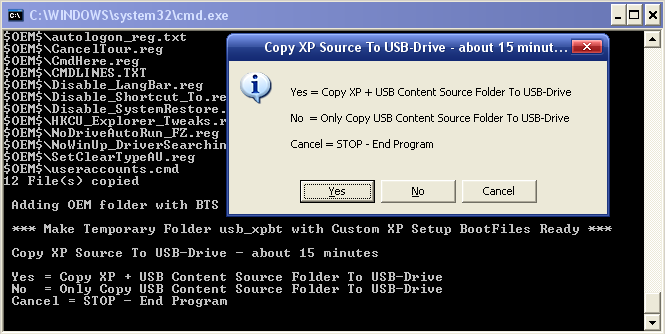
Copy XP source to usb stick

Click on Yes to continue. The script will then copy windows XP to the Usb drive. This may take a while depending on the write speed of your Usb stick.
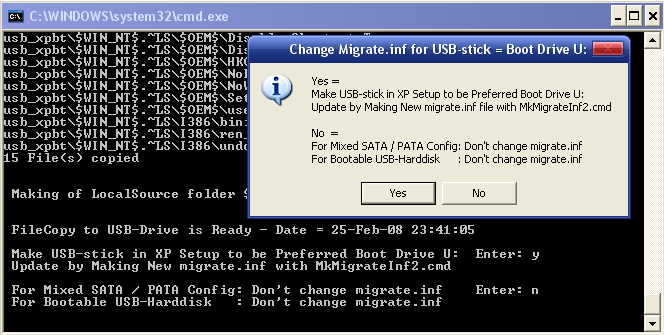
Change Migrate.inf

Click on Yes to continue. When the script finishes click on 'Any' key to close the command window.


Booting

Insert your Usb stick and start your computer. Make sure your Eee pc is configured with your USB flash drive as the first boot device in the BIOS. If you have properly selected the flash drive as your primary boot device you will get a startup menu. Select option 1 'TXT Mode setup windows XP'. You have to delete ALL partitions and create a single partition. Use only C: Drive of the hard disk as the partition for installation of Windows XP and then select Quick format with NTFS file system.

Note - A small portion will be unavailable to partition. This is normal. In this example, it is 2 MB.
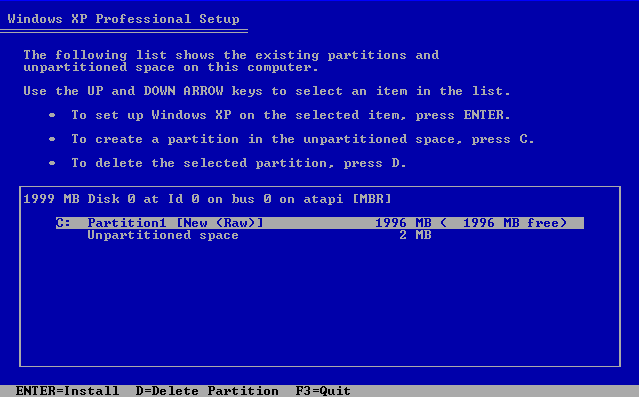
Setup Windows Xp partition


From this point on the installation is just like a normal XP installation. Once the text mode portion of the setup is complete it will boot into GUI mode. Do not remove the Usb flash stick until you see the XP desktop.

I hope this worked for you. There is a basic Help file (Help_USB_MultiBoot2.txt) in Help_Info folder which you can use for trouble shooting if incase you encounter some problems or you can even email me. Use Nlite to reduce the size of your XP installation. On the Asus Eee PC space is a premium. Note - If you use Nlite make sure you don't remove the manual installation files.

Note - You can disable System Restore and Paging file, you don't really need them on the Eee PC.
Do not connect any other Usb hard disk during the installation. It screws up the drive letter order.


Sumedh k


CommentPost a Comment

User Comments

Sinuce writes...
It's working now, thanks!
It seems like my previous comment didn't get through;

I used another USB drive and a virtual Windows XP, and it worked.
Posted on August 27, 2010 02:31 PM
Sinuce writes...
I tried using a standard 2GB USB flash drive (both in Win7 and WinXP). After following the steps, I get "drive does not have FAT format and is NOT valid" when Pressing 3 and entering the drive letter of my USB drive.
Can't find a solution on Google... Stuck...
Posted on August 21, 2010 12:51 PM
Pawan writes...
Awesome.. thnk you .. helped greatly .. solved my trouble atleast !!
Posted on August 13, 2010 05:48 PM
Jaye writes...
Thank you so much! Keep up the good work! =)
Posted on August 5, 2010 12:57 PM
Jaye writes...
Thank you so much... Keep up the good work! =D
Posted on August 5, 2010 12:56 PM
kman writes...
i got a virusscan warning when extracting the files multiboot.zip
anyone have this problem?
Posted on July 20, 2010 03:03 PM
ed writes...
id type bootsect.exe /nt52 J: (J my USB drive letter) but i doesnt work for me T_T
Posted on July 8, 2010 03:34 PM
Dell writes...
this is a great writeup... i thought i have screwed my mother in law's eepc when i deleted the partition when it no longer shows in fdisk... this saves me lots of time and resources... thumb's up to you...
Posted on June 7, 2010 11:32 AM
Barthd2 writes...
So it started up ok. Windows setup almost got to the choices to start partitioning, however. Now getting a Blue Screen of Death!

"A Problem has been detected and Windows has been shut down to prevent damage to your computer. If this is the first time you've seen this Stop error screen, restart your computer. If this screen appears again, follow these steps:

Check for viruses on our computer. Remove any newly installed hard drives or hard drive contollers. Check your hard drive to make sure it s propperly configured and terminated. Run CHKDSK /F to check for hard drive corruption and then restart your computer. Technical Information:
*** STOP: 0x0000007B (etc...)"

Any Ideas? Need to get check disk on here somehow I gather.

B-
Posted on May 13, 2010 12:55 AM
PAAPAK writes...
Well, the choosing of USB as the first boot device in BIOS did not work for me, THEN I TESTED with "Esc" key: pressing "Esc" did work and it did give me the choice of 2 alternatives: HDD & USB device ... and it started fine with USB .. the a manue came up which I chose the seconf choice 'TXT Mode setup windows XP ... ' as it says here but later it did NOT find any drivers to continue ...! Sure it is hidden and it cannot be found from my USB that we've made earlier ...! Sad but true ... ! Thanks anyway!
Posted on May 12, 2010 06:21 PM
paapak writes...
Sorry guys, it doesn't work - I did everything as it says here but it never starts from the USB. I've got Asus Eee PC 1005ha with the latest bios upgraded. Sadly an USB dvd driver is missing so I thought this might help me to delete the damn dual boot (my daughter does need ubuntu) but it didn't work for me. It is really irritating me and the kid ... seems to be out of our touch to bring down this garbage "grub 1.3XXX beta" each time the pc is started ....! She really hates UBUNTU!
Posted on May 12, 2010 05:32 PM
Newbie writes...
Hi, i really need help badly. My Auntie just bought a brand new eeePC and when you boot it up it loads the Asus Express Gate. I tried to reformat it using the USB Flash method. My porblem is on booting, i change the Boot Settings > Hard Disk Drives > and change the Flash Disk as its Primary or should i say 1st Device and the HDD as 2nd Drive. Boot Device Priority and the 1st boot is the USB, 2nd ATAPI CD-ROM 3rd Removable Device.

On boot up, i selected "Select option 1 'TXT Mode setup windows XP" then press enter to resume install windwos xp. Then the HARDDISK is not detected. The USB partition is only displayed.
What will I do??? I tried already changing the Hard Disk as 1st and USB as 2nd. When it boot, the USB is not read and just booted to ASUS Express Gate again.

My CMOS is
ASUS 1005P ACPI BIOS Revision 0706
Core Version: 0706
Build Date: 01/04/10
EC Firmware Version: EPCD-034

v02.58 Copyright American Megatrend Inc.

Please help me, email me at maiden_masher@hotmail.com.

Thank you in advance
Posted on April 3, 2010 12:14 PM
TSodoo writes...
Thank you
Posted on April 2, 2010 09:18 AM
Ataklti writes...
Thank You Verey Much may not be enough to express that i wante to say it.
Posted on March 31, 2010 03:01 PM
matt writes...
I am trying to make a windows xp bootable flash drive but my flash drive is not supported as it says its not fat i have used PeToUSB to make it FAT16, FAT32 and NTFS none of them work. I am trying to do this on a windows 7 machine could that be the problem?
Posted on March 23, 2010 05:58 AM
Lee, Leeds writes...
Hi Guys, just thought i'd share some thoughts from the comments you have posted and try and help. Worked a treat for me.

Ryan / Naigen - Before making the stick bootable go to my computer, then on your usb stick right click and press format. Move the drop down menu to FAT instead of FAT32 and format the stick. Simples...

Peter - If you get NTLDR is missing message it is probably because you are installing onto a blank h.disk and haven't changed your first boot priority to boot the USB stick. Go into the BIOS and change it there. You get that message when it isn't seeing the stick so it skips it and tries booting an Operating system on the h.disk and looks for NTLDR.

Sam - Try changing boot device in BIOS to boot the USB stick same as Peter.

MPAINO87 - The laptop/ pc may not support booting from a USB stick or may not like the stick your using. Try another stick, if not try different boot options for example USB-HDD, USB-ZIP Etc.

Harvs - When you navigate to the Win. XP setup CD and press Select it should display the drive letter on the source line in the window. if not it may not be reading source disc. If you cannot type anything in CMD try clicking it or ALT+TAB to switch to it. Or see if its unresponsive in task manager. COuld have other issues with PC.

Hope this helps
Posted on March 18, 2010 06:47 PM
stella muir writes...
awsome, thank you
Posted on March 18, 2010 03:02 PM
peter writes...
nid help ntldr is missing?
Posted on March 15, 2010 04:36 AM
mAc writes...
thanks it works fine on my 1gb flashdrive....
Posted on February 25, 2010 09:49 AM
Andy writes...
when specifying folder name where XP source files are located be sure the folder names (directories) do not contain spaces.
Posted on February 14, 2010 11:23 PM

Only the most recent comments are showing. You need JavaScript to view all the comments.